 e6765fa636
* init uv project

* fix workflow for uv

* updated docs

* update dependabot to use uv

* lock python version

* fix python version

* update uv deps

* Address PR review feedback

- Match dependency versions to dev branch (Django 5.2.13, allauth 65.15.1,
  health-check 4.2.2 with [celery,redis] extras, ruff 0.15.10, fakeredis[lua])
- Remove unused django-decorator-include
- Restore single-line ruff ignore array (unrelated whitespace)
- Drop description/readme; mark as non-package via [tool.uv]
- Install supervisor via apk in Dockerfile
- Fix CI: use 'uv run playwright install'; drop unused --all-extras
- README: set `dynamic = ["version"]` to avoid declaring version

Co-authored-by: Copilot <198982749+Copilot@users.noreply.github.com>

* Fix container startup after switch to uv base image

- Dockerfile: prepend /.venv/bin to PATH so python/gunicorn/celery
  resolve directly (entrypoint.sh and supervisord.conf invoke them by
  name).
- entrypoint.sh: drop hardcoded /usr/local/bin/ prefix for supervisord;
  apk installs it to /usr/bin/supervisord, so let PATH resolve it.
- uv.lock: regenerated after pyproject.toml switched to dynamic version.

Co-authored-by: Copilot <198982749+Copilot@users.noreply.github.com>

* Add mkdocs and supervisor as uv deps; lint pyproject.toml

- Add a 'docs' dependency group with mkdocs and its plugins; switch
  build-docs.yml to use uv and remove docs/requirements.txt.
- Add supervisor to project deps so it ships in /.venv/bin instead of
  via apk in the Docker image.
- Add validate-pyproject and pyproject-fmt as dev deps and pre-commit
  hooks; reformat pyproject.toml accordingly.
- Drop unused dynamic version metadata (app version comes from the
  VERSION env var, not package metadata).

Co-authored-by: Copilot <198982749+Copilot@users.noreply.github.com>

* Move uv virtualenv into /yamtrack workdir

Set WORKDIR before copying pyproject.toml and uv.lock so the
uv-managed virtualenv is created at /yamtrack/.venv. Update PATH
accordingly and ignore .venv in .dockerignore.

Co-authored-by: Copilot <198982749+Copilot@users.noreply.github.com>

* Pin Python version to 3.12

Add .python-version so uv (and pyenv) consistently select the
same interpreter when creating the virtualenv.

Co-authored-by: Copilot <198982749+Copilot@users.noreply.github.com>

* Enable uv bytecode compilation in Docker image

Set UV_COMPILE_BYTECODE=1 so uv precompiles .pyc files during
'uv sync'. This trades a small build-time cost for faster
container/worker startup since Python doesn't have to compile
modules on first import.

Co-authored-by: Copilot <198982749+Copilot@users.noreply.github.com>

* Use multi-stage Docker build to slim the runtime image

Build the virtualenv with uv in a builder stage based on
ghcr.io/astral-sh/uv:python3.12-alpine, then copy /yamtrack/.venv
into a clean python:3.12-alpine final stage. The final image no
longer carries the uv binary or its build cache, and collectstatic
runs via 'python manage.py' since the venv is on PATH.

Set UV_LINK_MODE=copy in the builder so packages are copied (not
symlinked from a cache that the final stage will not see).

Reduces image size by roughly 150 MB in local testing.

Co-authored-by: Copilot <198982749+Copilot@users.noreply.github.com>

* Drop validate-pyproject and pyproject-fmt; revert pyproject formatting

Remove the validate-pyproject and pyproject-fmt pre-commit hooks
and dev dependencies, and revert the cosmetic pyproject.toml
formatting that pyproject-fmt had applied (e.g. nested
[tool.ruff.lint.*] tables and tight list spacing) to match the
dev branch style.

Co-authored-by: Copilot <198982749+Copilot@users.noreply.github.com>

* Pin Alpine version and preserve bytecode in Docker build

- Pin both builder and final stages to alpine3.21 for reproducibility
  and binary compatibility between the virtualenv and runtime image.
- Stop deleting __pycache__ after uv sync so the bytecode compiled via
  UV_COMPILE_BYTECODE=1 is actually shipped, giving faster startup and
  avoiding runtime compilation on read-only filesystems.

Co-authored-by: Copilot <198982749+Copilot@users.noreply.github.com>

* Add django-tailwind-cli for Tailwind integration

Replaces the standalone tailwindcss CLI workflow with django-tailwind-cli,
which downloads and manages the standalone Tailwind binary itself. The
output path (static/css/main.css) is preserved so base.html and the
production build are unchanged.

Co-authored-by: Copilot <198982749+Copilot@users.noreply.github.com>

* Split dev dependency group into lint and test

The dev group now includes both via include-group, preserving the existing
'uv sync' behavior while allowing lint-only or test-only installs.

Co-authored-by: Copilot <198982749+Copilot@users.noreply.github.com>

* Revert "Add django-tailwind-cli for Tailwind integration"

This reverts commit 3796e53e347b81784e69fa0328c4e3d35be90d55.

Co-authored-by: Copilot <198982749+Copilot@users.noreply.github.com>

* Add back pinning version to `0.0.0`

Using `dynamic`, uv tries to build an egg every time dependencies are
added/removed.

* Switch docs group from mkdocs to zensical

Upstream migrated documentation tooling from mkdocs to zensical. Replace
the mkdocs-* plugins in the docs dependency group with zensical and the
squidfunk fork of mike that zensical expects.

Co-authored-by: Copilot <198982749+Copilot@users.noreply.github.com>

---------

Co-authored-by: Eddi <75438446+minerop5000@users.noreply.github.com>
Co-authored-by: Copilot <198982749+Copilot@users.noreply.github.com>
Co-authored-by: David Davis <86290+daviddavis@users.noreply.github.com>
Yamtrack




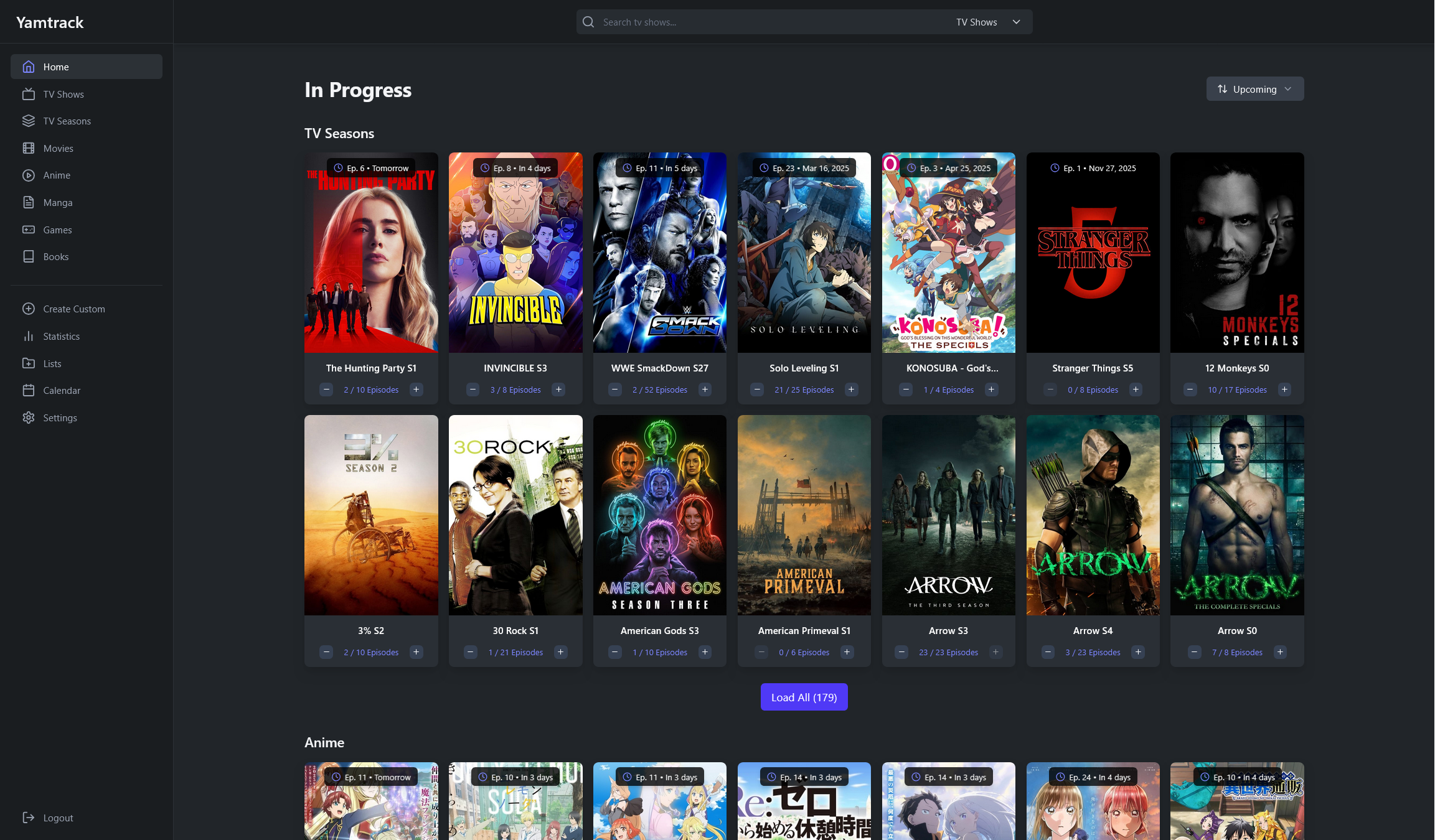
Yamtrack is a self hosted media tracker for movies, tv shows, anime, manga, video games, books, comics, and board games.
📚 Documentation
The full documentation is available at fuzzygrim.github.io/Yamtrack.
🚀 Demo
You can try the app at yamtrack.fuzzygrim.com using the username demo and password demo.
✨ Features
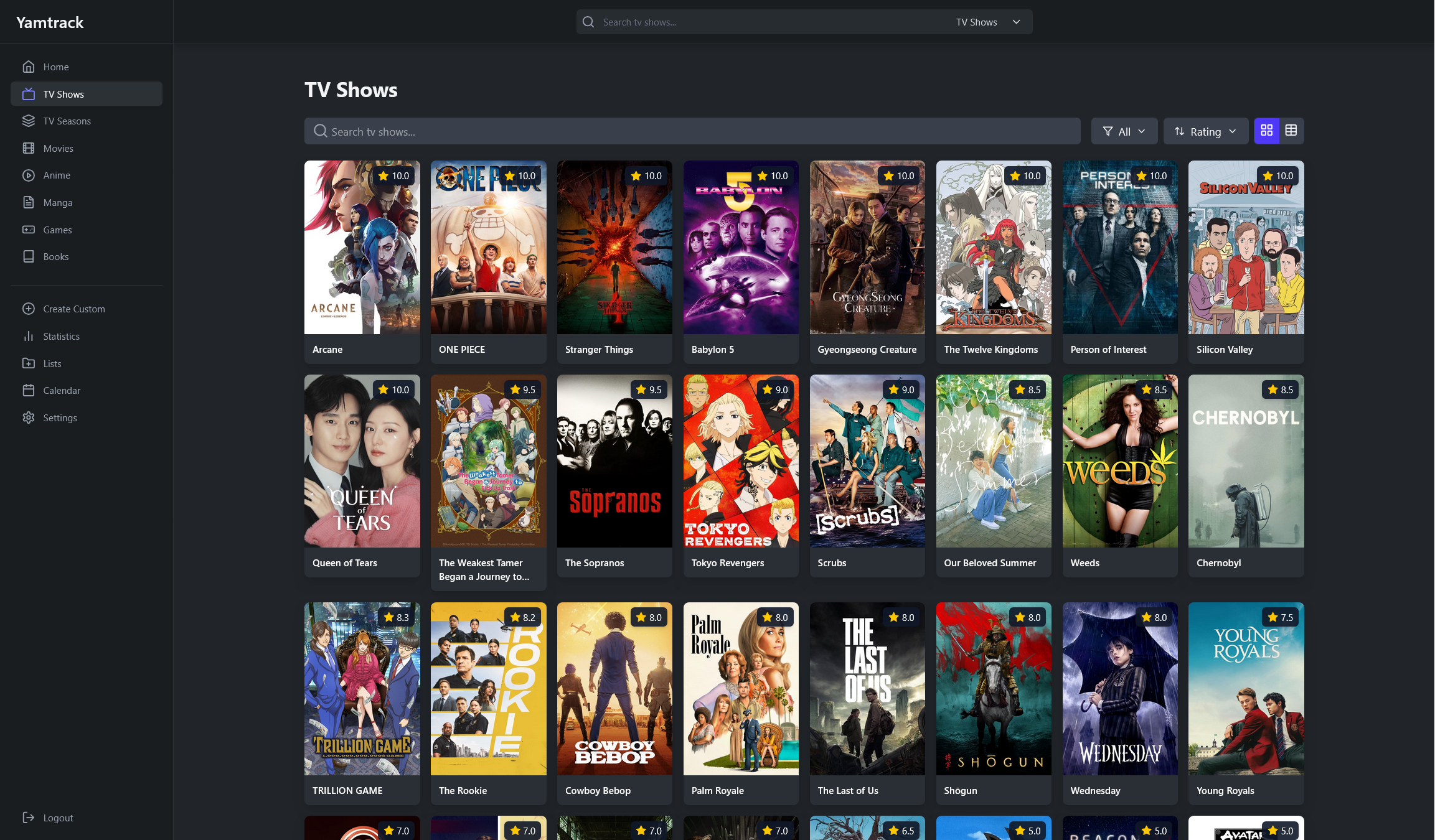
- 🎬 Track movies, tv shows, anime, manga, games, books, comics, and board games.
- 📺 Track each season of a tv show individually and episodes watched.
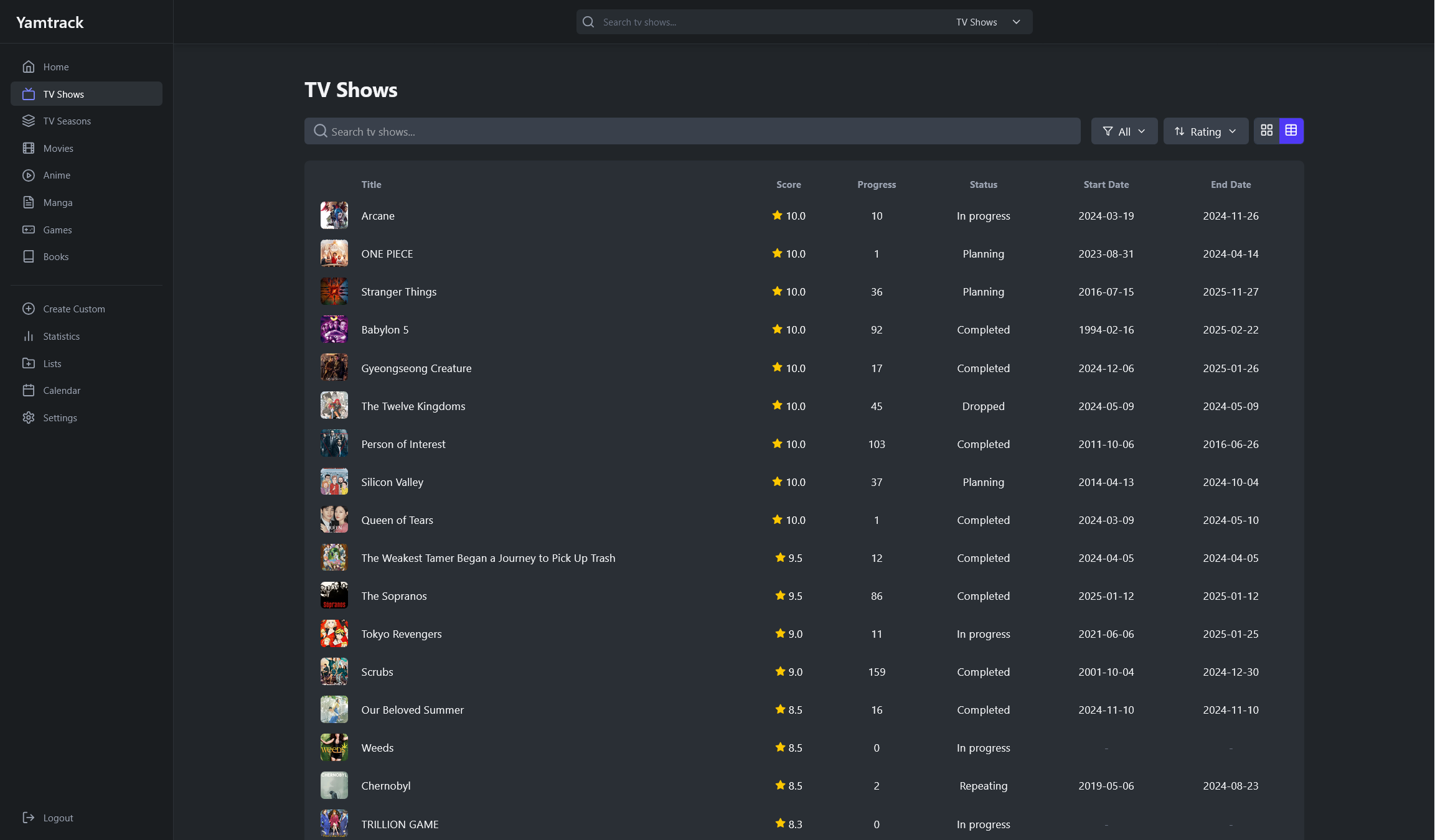
- ⭐ Save score, status, progress, repeats (rewatches, rereads...), start and end dates, or write a note.
- 📈 Keep a tracking history with each action with a media, such as when you added it, when you started it, when you started watching it again, etc.
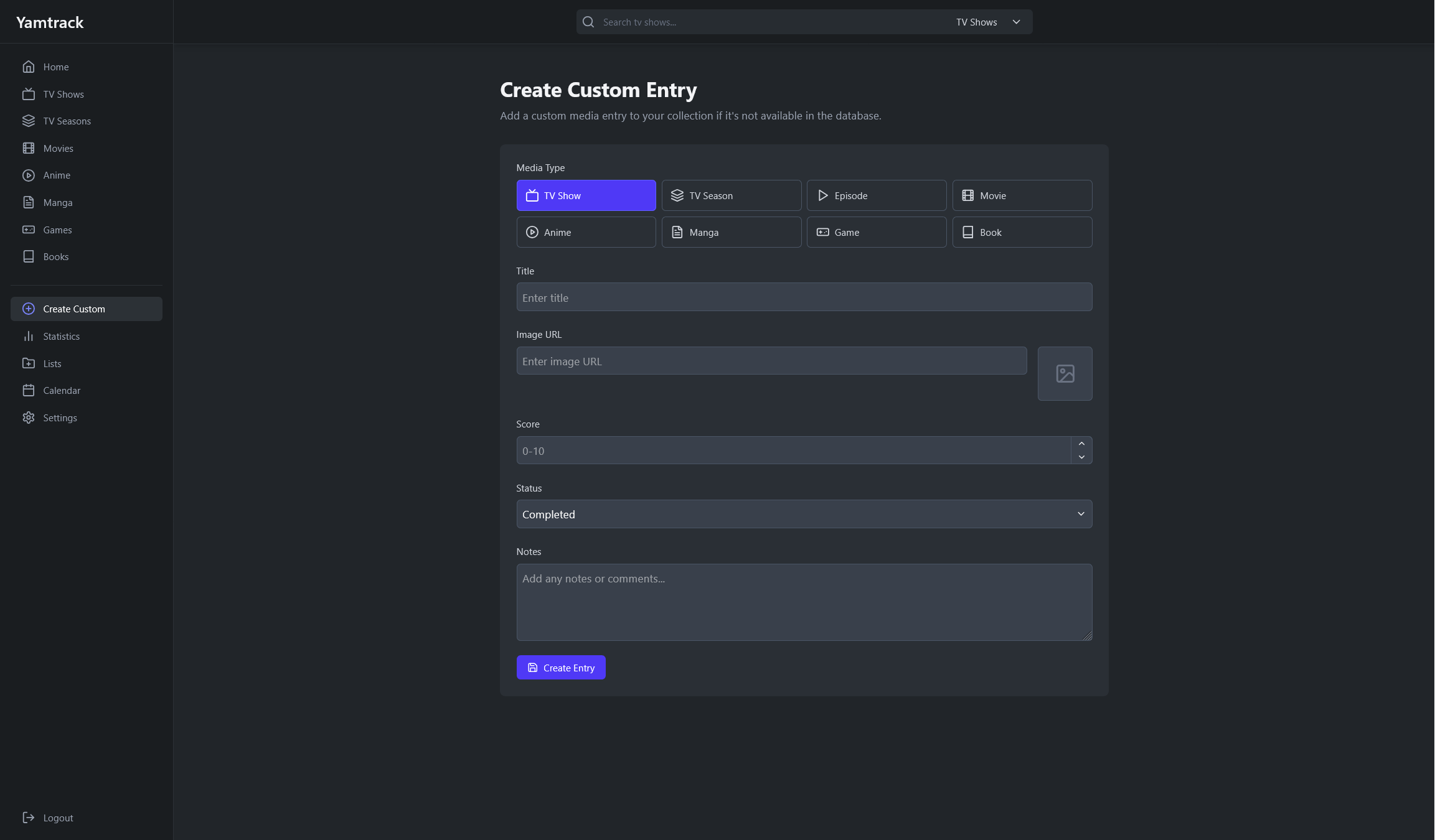
- ✏️ Create custom media entries, for niche media that cannot be found by the supported APIs.
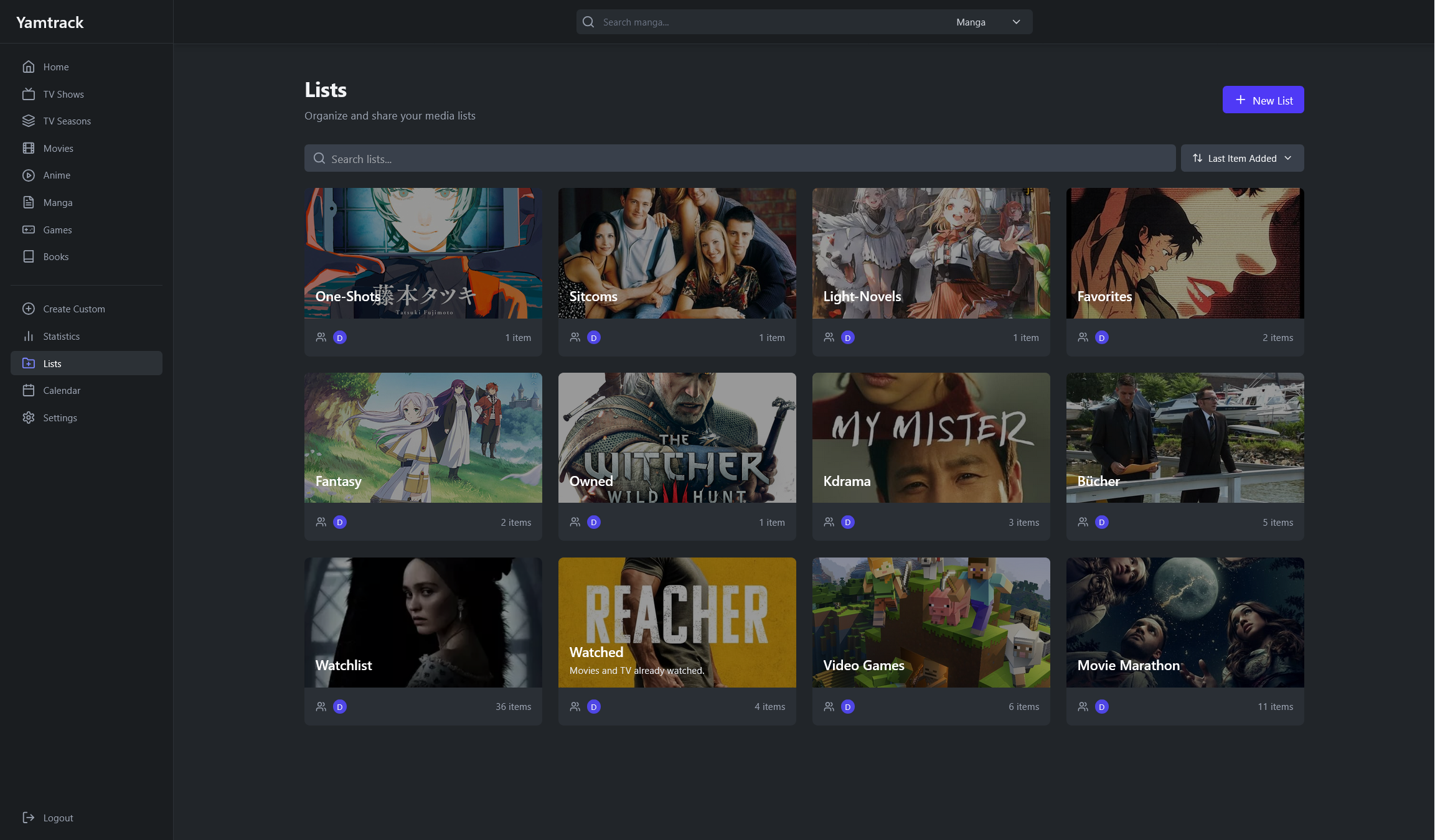
- 📂 Create personal lists to organize your media for any purpose, add other members to collaborate on your lists.
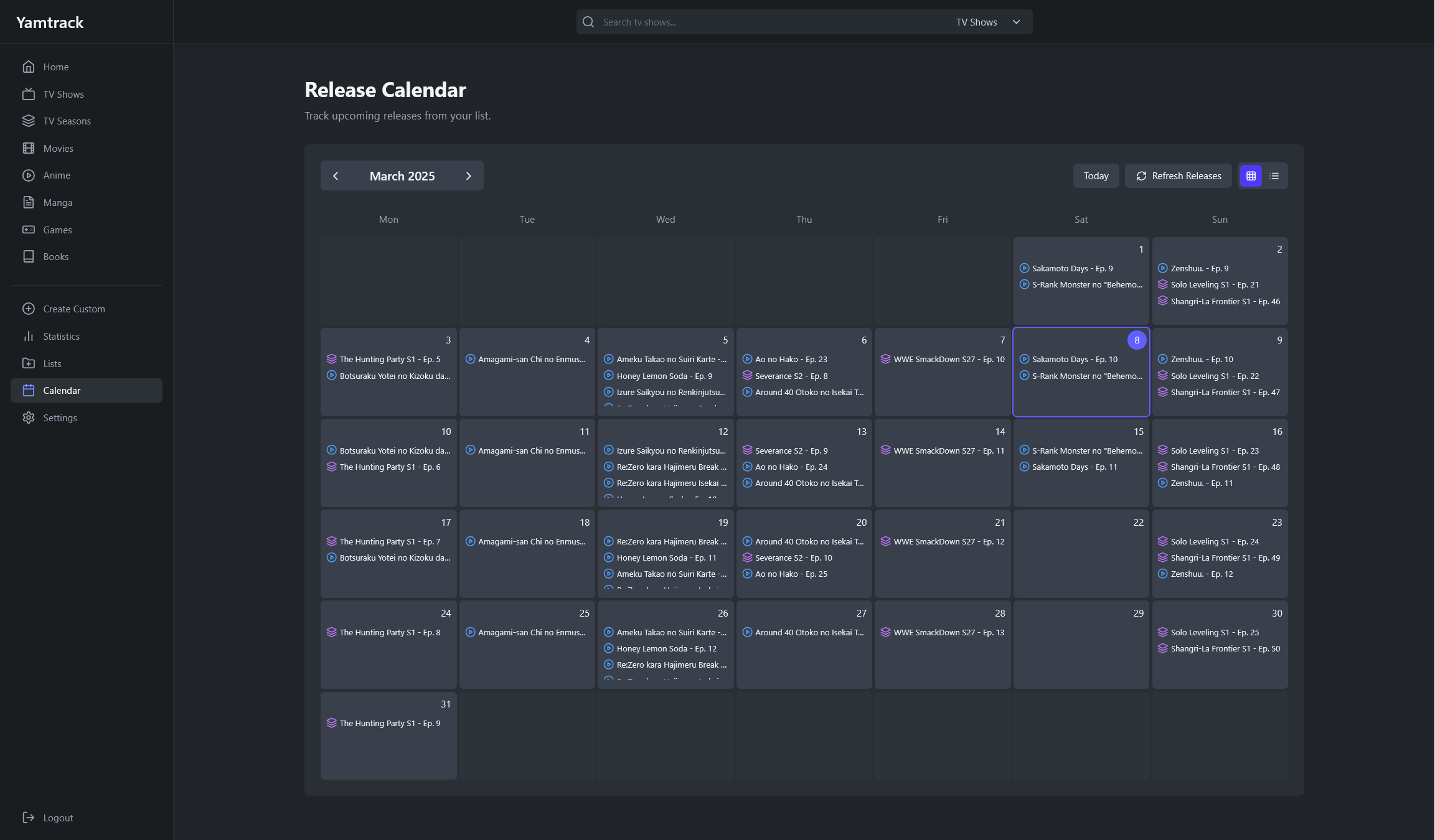
- 📅 Keep up with your upcoming media with a calendar, which can be subscribed to in external applications using a iCalendar (.ics) URL.
- 🔔 Receive notifications of upcoming releases via Apprise (supports Discord, Telegram, ntfy, Slack, email, and many more).
- 🐳 Easy deployment with Docker via docker-compose with SQLite or PostgreSQL.
- 👥 Multi-users functionality allowing individual accounts with personalized tracking.
- 🔑 Flexible authentication options including OIDC and 100+ social providers (Google, GitHub, Discord, etc.) via django-allauth.
- 🦀 Integration with Jellyfin, Plex and Emby to automatically track new media watched.
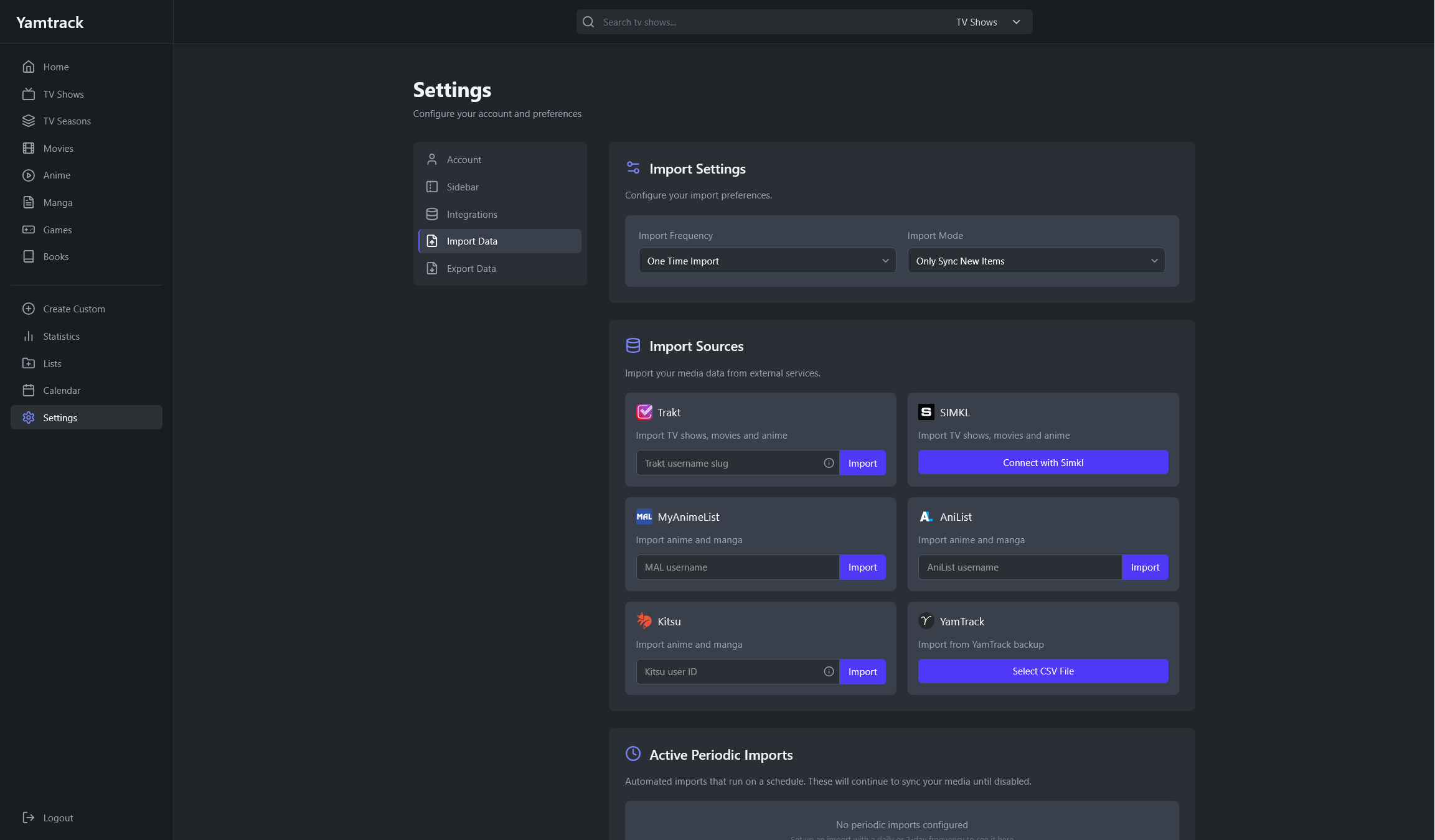
- 📥 Import from Trakt, Simkl, MyAnimeList, AniList and Kitsu with support for periodic automatic imports.
- 📊 Export all your tracked media to a CSV file and import it back.
📱 Screenshots
| Homepage | Calendar |
|---|---|
 |
 |
| Media List Grid | Media List Table |
|---|---|
 |
 |
| Media Details | Tracking |
|---|---|
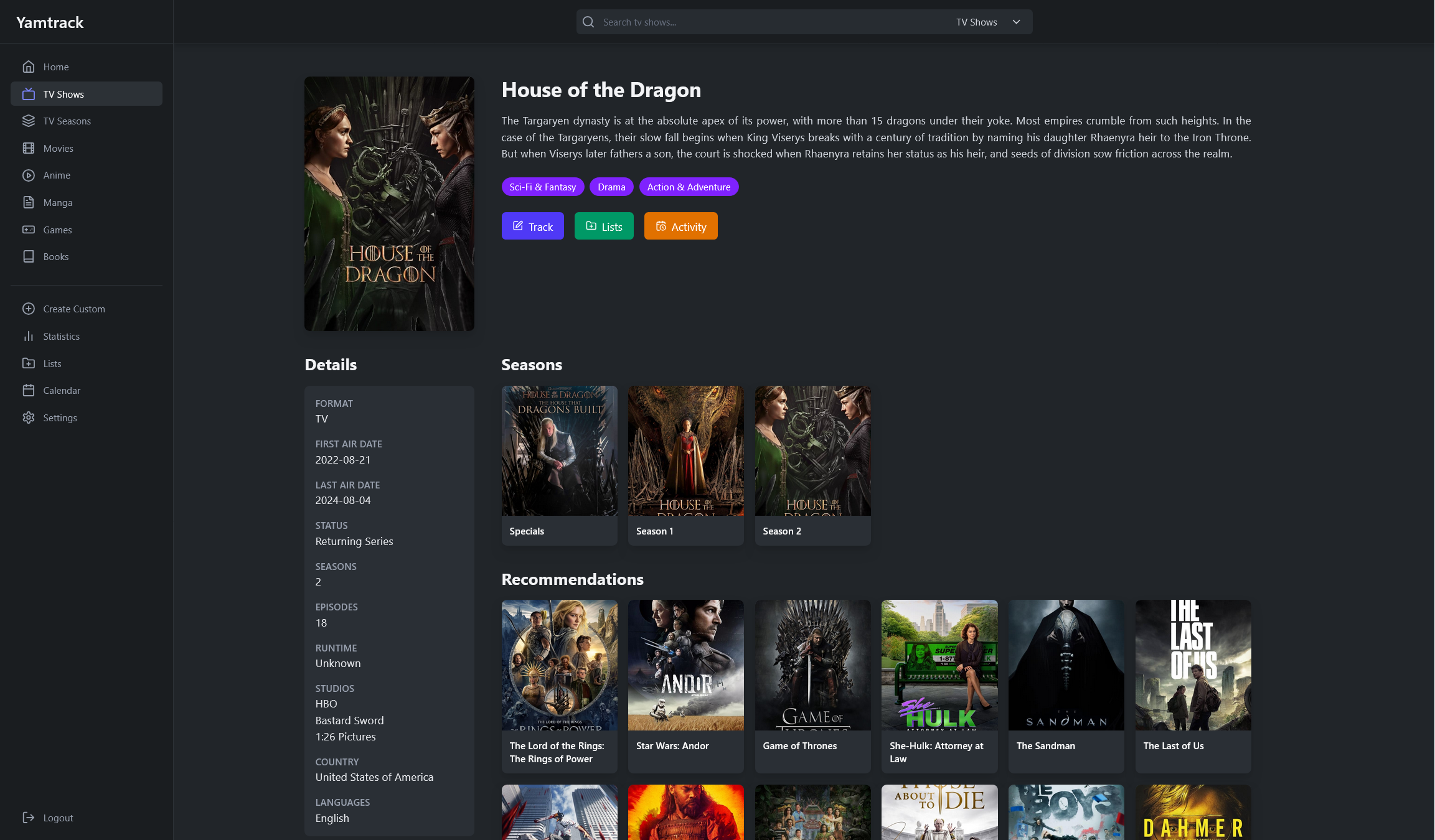 |
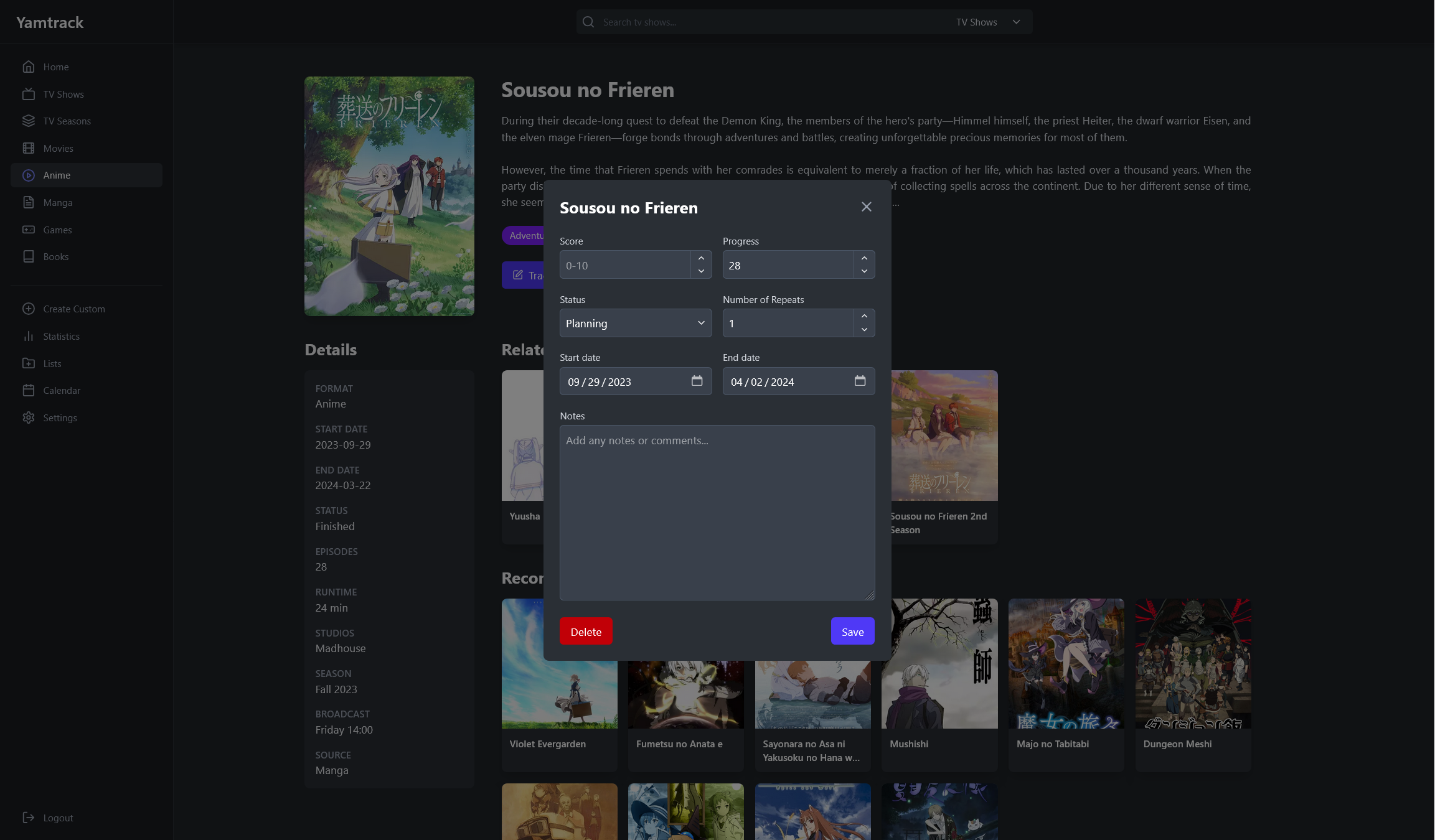 |
| Season Details | Tracking Episodes |
|---|---|
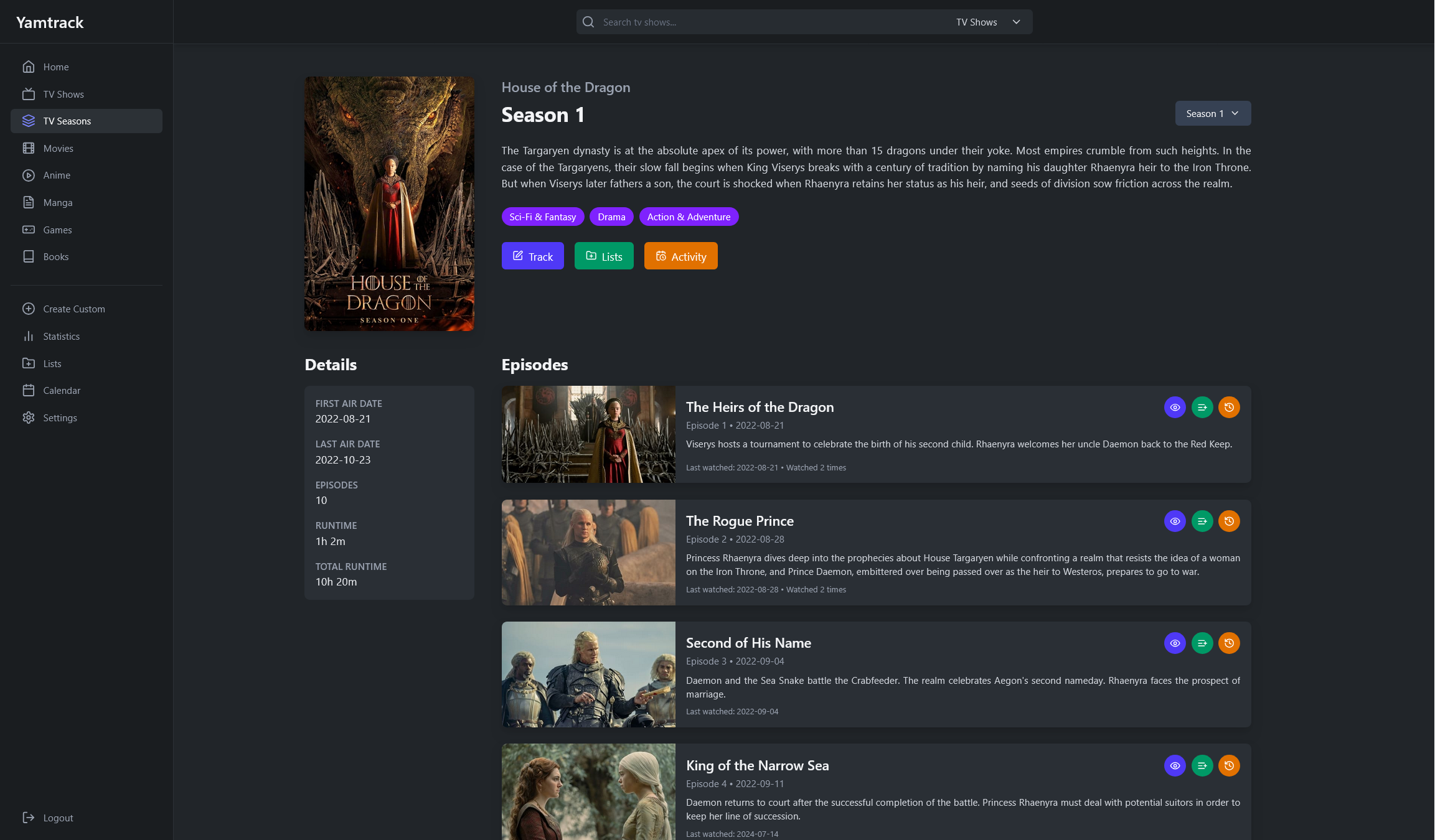 |
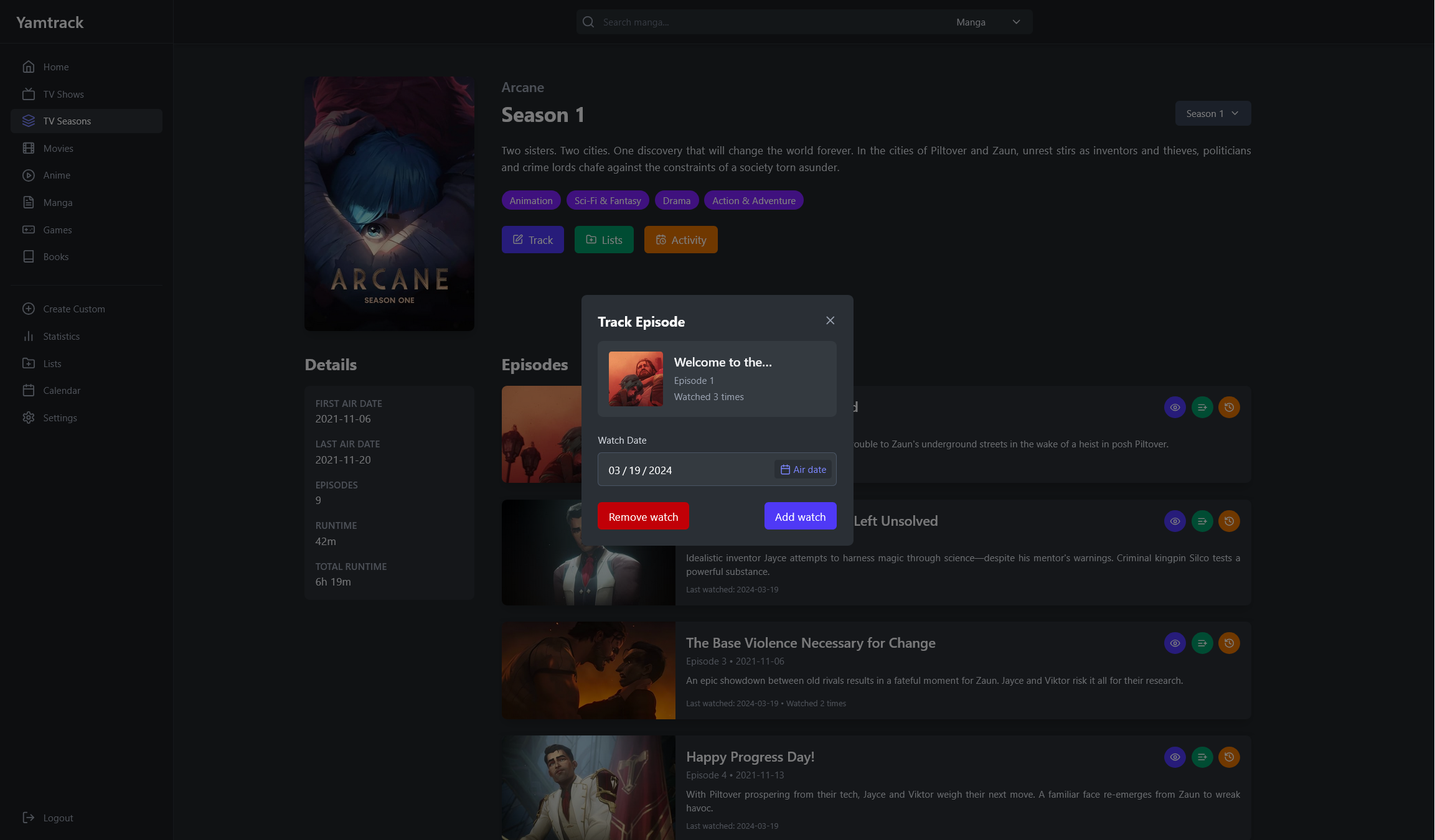 |
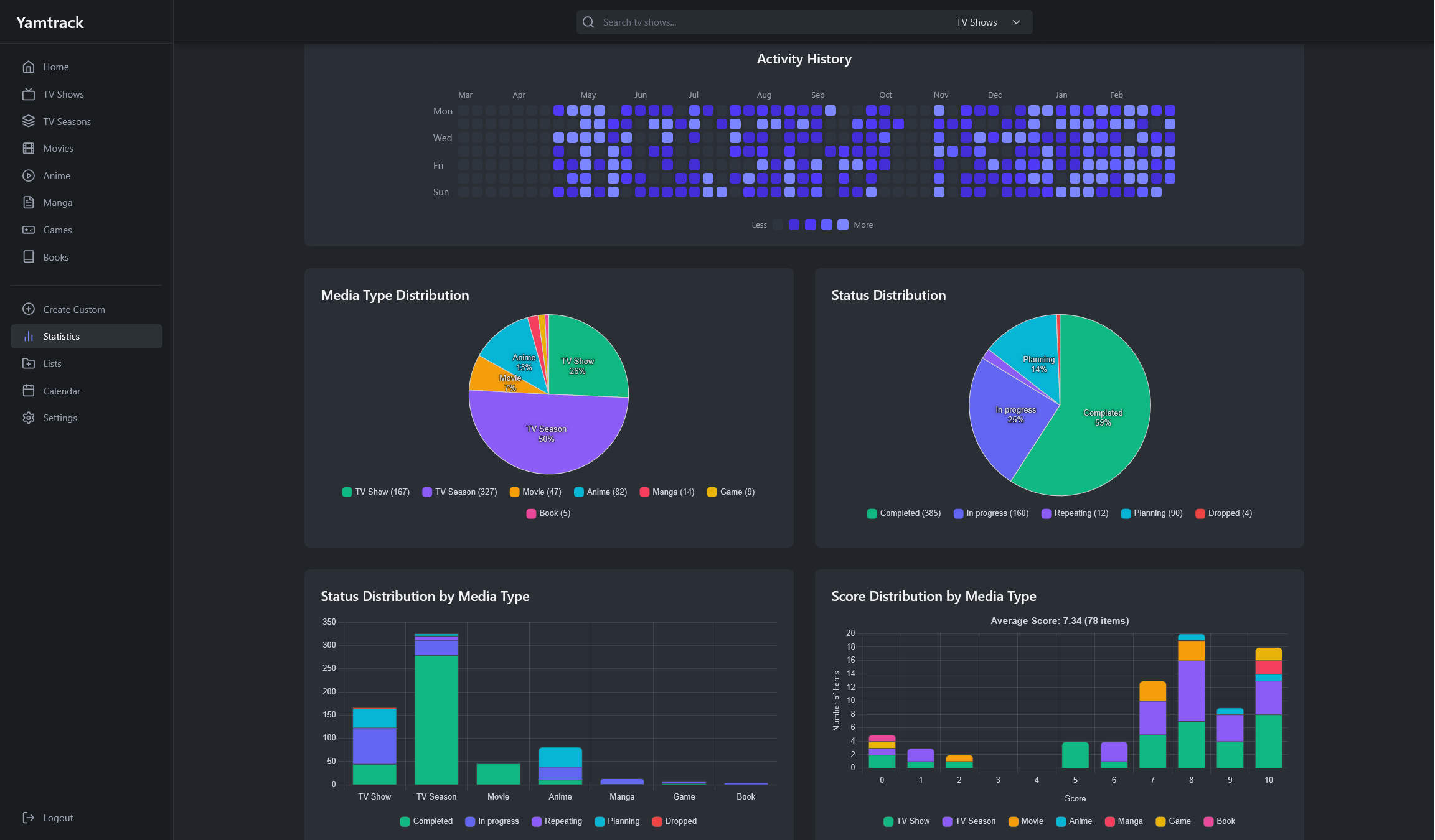
| Lists | Statistics |
|---|---|
 |
 |
| Create Manual Entries | Import Data |
|---|---|
 |
 |
🐳 Installing with Docker
Download the default docker-compose.yml file from the repository, update the environment values, and start Yamtrack:
docker compose up -d
The default Compose file uses SQLite, which is enough for most personal installs. For full SQLite, PostgreSQL, and reverse proxy setup instructions, see the Setup documentation.
💻 Development
Development instructions are available in the Development documentation.
💪 Support the Project
There are many ways you can support Yamtrack's development:
⭐ Star the Project
The simplest way to show your support is to star the repository on GitHub. It helps increase visibility and shows appreciation for the work.
🐛 Bug Reports
Found a bug? Open an issue on GitHub with detailed steps to reproduce it. Quality bug reports are incredibly valuable for improving stability.
💡 Feature Suggestions
Have ideas for new features? Share them through GitHub issues. Your feedback helps shape the future of Yamtrack.
🧪 Contributing
Pull requests are welcome! Whether it's fixing typos, improving documentation, or adding new features, your contributions help make Yamtrack better for everyone.
☕ Donate
If you'd like to support the project financially:
