 e564ce7b1f
* ♻️ Add/update indirect Go dependencies in kernel

Update kernel/go.mod and kernel/go.sum to add multiple indirect modules and checksum entries. Notable additions include github.com/fastschema/qjs, github.com/filecoin-project/go-jsonrpc, github.com/ipfs/go-log/v2, go.opencensus.io, go.uber.org/{atomic,multierr,zap}, golang.org/x/xerrors and github.com/golang/groupcache among many transitive entries. Changes ensure transitive dependencies are pinned and go.sum checksums are present (likely produced by `go mod tidy`) to make builds reproducible.

* refactor: export bazaar.GetCurrentBackend for kernel plugin platform matching

Co-Authored-By: Claude Sonnet 4.6 <noreply@anthropic.com>

* build: promote qjs to direct dependency for kernel plugin system

Co-Authored-By: Claude Sonnet 4.6 <noreply@anthropic.com>

* feat(plugin): add KernelPlugin struct with QJS runtime lifecycle and state machine

Introduces plugin/plugin.go with KernelPlugin owning an isolated QuickJS
runtime, a mutex-serialized call path, RPC method registration/dispatch,
Promise awaiting, JSON round-trip result conversion, and WebSocket tracking.
Adds sandbox_stub.go as a temporary no-op stub for injectSandboxGlobals.

Co-Authored-By: Claude Sonnet 4.6 <noreply@anthropic.com>

* feat(plugin): add PluginManager singleton for kernel plugin discovery and lifecycle

* feat(plugin): add sandbox injection scaffold with siyuan.log

Co-Authored-By: Claude Sonnet 4.6 <noreply@anthropic.com>

* feat(plugin): implement siyuan.storage CRUD scoped to petal storage directory

Co-Authored-By: Claude Sonnet 4.6 <noreply@anthropic.com>

* feat(plugin): implement siyuan.fetch with browser-like Response interface

* feat(plugin): implement siyuan.socket with browser-compatible WebSocket API

- Add sync import for mutex-protected WebSocket connection tracking
- Implement __siyuan_socket Go function that creates browser-compatible WebSocket objects
- Support send() method with queueing for messages sent before connection opens
- Support close() method for closing the WebSocket connection
- Track connection state via readyState property (0=CONNECTING, 1=OPEN, 3=CLOSED)
- Connect to kernel WebSocket endpoint with automatic auth token injection
- Run WebSocket I/O in background goroutine with proper cleanup
- Wire up siyuan.socket JS API

Co-Authored-By: Claude Sonnet 4.6 <noreply@anthropic.com>

* feat(plugin): implement siyuan.rpc.register for JSON-RPC method registration

* feat(plugin): add JSON-RPC 2.0 handler for kernel plugin method dispatch

* feat(plugin): register /api/plugin/rpc/:name and /ws/plugin/rpc/:name routes

Co-Authored-By: Claude Sonnet 4.6 <noreply@anthropic.com>

* feat(plugin): wire kernel plugin manager start/stop into main lifecycle

* feat(plugin): hook SetPetalEnabled to start/stop kernel plugins on enable/disable

* test(plugin): add unit tests for kernel plugin state machine and eligibility

* test(plugin): add comprehensive unit tests for manager, sandbox, and RPC handlers

* refactor(plugin): Export IsTargetSupported and update usages

Rename isTargetSupported to exported IsTargetSupported and adjust its comment. Replace local calls with bazaar.IsTargetSupported in kernel/bazaar and kernel/plugin/manager, removing the duplicated isKernelEligible helper. Update tests to import bazaar, call the new function, and change expectations to reflect that nil/empty kernel slices are treated as supported (i.e. supported on all platforms).

* refactor(plugin): initialize PluginManager in main and update related usages

* refactor(plugin): update JWT handling and plugin initialization for kernel plugins

* refactor(plugin): enhance plugin initialization and improve sandbox global injections

* refactor(kernel-plugin): Refactor plugin RPC registration and sandbox integration

- Removed deprecated tests and refactored existing tests for clarity and efficiency.
- Updated RPC method registration to use `bind` and `unbind` methods for better clarity.
- Enhanced the `injectSandboxGlobals` function to include additional properties for the plugin.
- Improved error handling in RPC methods and ensured proper state management for plugins.
- Added benchmarks for map to JS conversion performance.
- Cleaned up unused imports and organized code structure for better readability.

* refactor(plugin): enhance concurrency handling and improve WebSocket integration

* refactor(kernel-plugin): enhance RPC method handling and improve function registration

* feat(kernel-plugin): add RPC method info retrieval and enhance plugin management

* refactor(plugin): add plugin management endpoints and enhance plugin info retrieval

* refactor(kernel-plugin): enhance RPC method handling and improve plugin info retrieval

* refactor(kernel-plugin): improve error handling and response structures in RPC methods

* refactor(kernel-plugin): improve error handling in RPC methods and enhance WebSocket closure management

* fix(kernel-plugin): initialize sockets and socketMus maps in NewKernelPlugin

* feat(kernel-plugin): add wsWrite helper and fix PushNotification omitempty

Add wsWrite method on KernelPlugin that acquires the per-connection write
mutex before sending a text frame, returning nil for untracked connections.
Fix PushNotification's Params field to use omitempty for JSON-RPC 2.0 §4.2
compliance. Add rpc_test.go with newTestWsPair helper and tests for wsWrite.

Co-Authored-By: Claude Sonnet 4.6 <noreply@anthropic.com>

* feat(kernel-plugin): add BroadcastNotification and per-connection write mutex

Co-Authored-By: Claude Sonnet 4.6 <noreply@anthropic.com>

* feat(kernel-plugin): expose siyuan.rpc.broadcast in plugin sandbox

Add rpc.broadcast(method, params) binding in injectRpc so JS plugins
can push JSON-RPC 2.0 notifications to all connected server clients.
Fix deadlock by introducing a dedicated socketsMu RWMutex for the
sockets map, decoupling socket tracking from the main plugin mutex
that is held during Start()/Eval().

* fix(kernel-plugin): double-unlock in send handler and document PushNotification write-safety

Remove spurious mu.Unlock() inside the nil-conn branch of injectSocket's
CONNECTING-state send handler; the outer unconditional unlock is sufficient,
so the inner one causes a panic under concurrent load.

Document that PushNotification bypasses per-connection write serialization
and must not be called concurrently with BroadcastNotification/wsWrite on
the same connection without external locking.

Co-Authored-By: Claude Sonnet 4.6 <noreply@anthropic.com>

* style(kernel-plugin): align struct field declarations in KernelPlugin

Co-Authored-By: Claude Sonnet 4.6 <noreply@anthropic.com>

* fix(kernel-plugin): omit params field from JsonRpcRequest when nil (JSON-RPC 2.0 §4.1)

Per spec, params MAY be omitted; add omitempty so marshaled requests
with no parameters do not emit "params":null.

Co-Authored-By: Claude Sonnet 4.6 <noreply@anthropic.com>

* refactor(kernel-plugin): change JsonRpcRequest.Params to *json.RawMessage

A pointer correctly models the three-way distinction:
- nil      → params key absent (omitted from marshal output via omitempty)
- non-nil → params present (null, array, or object)

The previous []byte omitempty omitted the key only for nil/empty slices
and could not distinguish absent from explicit null on the wire.

Co-Authored-By: Claude Sonnet 4.6 <noreply@anthropic.com>

* refactor(kernel-plugin): unify method naming conventions and improve JSON-RPC request handling

* fix(kernel-plugin): improve WebSocket message handling and ensure thread safety with mutexes

* fix(kernel-plugin): enhance WebSocket handling and improve error management in storage methods

* fix(kernel-plugin): rename JsonRpcRequestRaw to JsonRpcInboundRequest and update related methods

* fix(kernel-plugin): improve plugin management and error handling in kernel plugin methods

* fix(kernel-plugin): rename kernel field to kernels and update related references

* feat(kernel-plugin): implement logging and improve concurrency handling in plugin manager and storage methods

* feat(kernel-plugin): enhance RPC parameter handling and add JSON array parsing support

* refactor(kernel-plugin): refactor RPC handling and improve logging functionality

* refactor(kernel-plugin): streamline loggerWrapper function and improve error handling in injectFetch

* refactor(kernel-plugin): optimize injectFetch function and enhance error handling

* feat(kernel-plugin): add onLoaded hook and enhance plugin lifecycle management

* feat(kernel-plugin): add ObjectFreeze and ObjectSeal functions to enhance API security

* feat(kernel-plugin): add InitJwtKey function to generate JWT signing key

* refactor(kernel-plugin): enhance error handling and logging in plugin lifecycle methods

* feat(kernel-plugin): improve WebSocket error handling and add concurrency support in BroadcastNotification

* feat(kernel-plugin): enhance error handling in storage and fetch methods with panic recovery

* feat(kernel-plugin): enhance PluginManager concurrency and error handling with sync.Map and atomic operations

* feat(kernel-plugin): refactor PluginState to use atomic operations for improved concurrency

* feat(kernel-plugin): add PluginStateLoaded and update state management in plugin lifecycle

* refactor(kernel-plugin): update logging level in loadPetals and refactor loggerWrapper return values

* feat(kernel-plugin): simplify invokeHook and enhance error handling in Object methods

* feat(kernel-plugin): remove obsolete test files for plugin functionality

* refactor(kernel-plugin): implement loggerWrapper and rpcParamsToJsValue functions for improved logging and RPC parameter handling

* feat(kernel-plugin): introduce Worker for serializing plugin tasks and enhance context management

* refactor(worker): enhance task execution with callback support and graceful shutdown

- Introduced a callback mechanism in the Task struct to handle results and errors.
- Updated the Run method to accept a callback, allowing immediate handling of task results.
- Added a RunSync method for synchronous task execution with result retrieval.
- Implemented atomic closure state management to prevent task submission after closure.
- Enhanced the Close method to ensure graceful shutdown and wait for the worker to finish processing.

* feat(kernel-plugin): refactor storage and RPC methods to use PromiseRun for better error handling

* feat(kernel-plugin): enhance plugin event handling with lifecycle and RPC event subscriptions

* refactor(kernel-plugin): replace PromiseRun with worker.Run for improved error handling in event and storage methods

* chore(kernel-plugin): add goja dependency, drop qjs

* chore(kernel-plugin): delete KernelPluginLogger (qjs stdout/stderr only)

* refactor(kernel-plugin): replace qjs runtime with goja in plugin.go

Co-Authored-By: Claude Sonnet 4.6 <noreply@anthropic.com>

* test(kernel-plugin): add sandbox utility tests (pre-rewrite)

* refactor(kernel-plugin): rewrite sandbox utility functions for goja

Replace goValueToJsValue, getJsContextValue, dispatchEvent with goja
implementations; add convertJsonNumbers helper; stub ObjectFreeze and
ObjectSeal as no-ops; delete dead qjs-only helpers (invokeRpcMethod,
PromiseAwait, rpcParamsToJsValue, parseJsonArrayStringToJsValueArray,
parseJsonStringToJsValue, loggerWrapper, ObjectSetDataMethods).

Co-Authored-By: Claude Sonnet 4.6 <noreply@anthropic.com>

* refactor(kernel-plugin): rewrite sandbox.go inject functions for goja

Replace all qjs-based inject functions (injectGlobalContext, injectPlugin,
injectLogger, injectEvent, injectStorage, injectFetch, injectSocket, injectRpc)
with goja equivalents. Add ObjectSetDataMethods and loggerWrapper helpers.
Remove all remaining qjs dead code; ObjectFreeze/ObjectSeal now call
Object.freeze/seal via goja AssertFunction.

Co-Authored-By: Claude Sonnet 4.6 <noreply@anthropic.com>

* test(kernel-plugin): add plugin lifecycle and RPC integration tests

Co-Authored-By: Claude Sonnet 4.6 <noreply@anthropic.com>

* chore(kernel-plugin): go mod tidy after qjs removal

Remove fastschema/qjs from go.mod and go.sum, add go-sourcemap as
indirect (transitive dep of dop251/goja), mark go-sourcemap indirect.

Co-Authored-By: Claude Haiku 4.5 <noreply@anthropic.com>

* fix(kernel-plugin): fix invokeHook early-return on subscribe failure, safe await extraction, and goja value cross-goroutine access in socket methods

* refactor(kernel-plugin): replace goValueToJsValue with goValueToJsValueSafely in sandbox functions and tests

* feat(plugin): enhance plugin management and error handling

- Added GetLoadedPlugin method to retrieve loaded plugin info by name.
- Introduced file path for kernel.js in KernelPlugin struct.
- Updated Eval method to use the new file path for script execution.
- Improved error handling in injectGlobalContext and other injection functions using recover.
- Refactored task execution in Worker to use clearer types for task executors and callbacks.
- Enhanced storage methods to ensure proper error handling and logging.
- Updated loggerWrapper to handle errors more gracefully.
- Ensured consistent use of error handling patterns across various plugin methods.

* refactor(worker): enhance task execution with goja runtime integration

- Updated TaskExecutor and TaskCallback signatures to accept *goja.Runtime.
- Modified Worker to start processing tasks with an event loop.
- Improved error handling in task execution to catch panics from both executor and callback.
- Renamed Close method to Stop for clarity on worker shutdown behavior.

* refactor(kernel-plugin): streamline worker implementation and update context handling in plugin methods

* refactor(kernel-plugin): update event handler to use byte slices and improve event dispatching

* refactor(worker): simplify RunSync method by removing unnecessary select statement

* refactor(kernel-plugin): enhance plugin lifecycle management and improve RPC method binding

* refactor(kernel-plugin): improve error logging in data methods for better debugging

* refactor(kernel-plugin): add version field to plugin data structures and update related methods

* refactor(kernel-plugin): replace JsonRpcInboundRequest with JsonRpcRequest and update related methods

* refactor(kernel-plugin): enhance plugin lifecycle hooks and improve RPC method invocation

* feat(kernel-plugin): improve error handling and response processing in fetch and socket methods

* refactor(kernel-plugin): update invokeFunction to handle promise results correctly

* refactor(kernel-plugin): streamline event handling and remove unused JSON marshaling functions

* refactor(kernel-plugin): improve error handling in start method and add event publishing for lifecycle states

* refactor(kernel-plugin): move logging to separate function and execute in goroutines for improved performance

* feat(kernel-plugin): add unique ID generation for start and stop events

* refactor(kernel-plugin): enhance error handling and concurrency in storage operations

Co-authored-by: Copilot <copilot@github.com>

* fix(kernel-plugin): remove unexpected resolve in fetch function

* feat(kernel-plugin): enhance JSON-RPC request handling with optional parameters and improved error reporting

Co-authored-by: Copilot <copilot@github.com>

* refactor(kernel-plugin): rename await to async in dispatchEvent function for clarity

Co-authored-by: Copilot <copilot@github.com>

* fix(kernel-plugin): improve error handling in RPC method execution and hook invocation

* feat(kernel-plugin): implement custom JSON marshaling for JsonRpcRequest to handle optional parameters

* feat(kernel-plugin): add error codes for plugin state and improve error handling in RPC responses

Co-authored-by: Copilot <copilot@github.com>

* refactor(kernel-plugin): clean up context usage and improve error logging for RPC methods

* feat(kernel-plugin): add buffer method to object for asynchronous data processing

* fix(kernel-plugin): Fixed the problem of blocking when plug-in life cycle function is not bound

Co-authored-by: Copilot <copilot@github.com>

* feat(kernel-plugin): implement public and private web server handlers and enhance request handling

Co-authored-by: Copilot <copilot@github.com>

* feat(kernel-plugin): enhance server request handling and introduce server handler invocation

Co-authored-by: Copilot <copilot@github.com>

* feat(kernel-plugin): enhance response handling and add jsValueToBytes conversion utility

Co-authored-by: Copilot <copilot@github.com>

* feat(kernel-plugin): comment out public web server route in router

* feat(kernel-plugin): add WebSocket and EventSource proxy handlers and update sandbox integration

Co-authored-by: Copilot <copilot@github.com>

* feat(kernel-plugin): implement HTTP proxy handler with response header forwarding

* refactor(kernel-plugin): refactor siyuan.client.* methods

* feat(kernel-plugin): add support for EventSource with SSE handling and response header forwarding

Co-authored-by: Copilot <copilot@github.com>

* feat(kernel-plugin): add SSE support using r3labs/sse library for EventSource handling

* feat(kernel-plugin): enhance SSE client with onclose event handling

Co-authored-by: Copilot <copilot@github.com>

* feat(kernel-plugin): implement SSE event handling and error management in server-sent events

* feat(kernel-plugin): refactor SSE handling and introduce request handler utility functions

Co-authored-by: Copilot <copilot@github.com>

* feat(kernel-plugin): enhance WebSocket message handling with buffered amount tracking and cleanup

Co-authored-by: Copilot <copilot@github.com>

* perf(kernel-plugin): improve WebSocket message handling with channel-based message sending and error management

Co-Authored-By: Copilot <copilot@github.com>

* refactor(kernel-plugin): remove invokeServerHandler

Co-Authored-By: Copilot <copilot@github.com>

* feat(kernel-plugin): implement WebSocket message handling with improved structure and error management

Co-authored-by: Copilot <copilot@github.com>

* refactor(kernel-plugin): Refactor code structure for improved readability and maintainability

* refactor(kernel-plugin): streamline HTTP client creation and enhance event source state management

Co-authored-by: Copilot <copilot@github.com>

* refactor(kernel-plugin): enhance WebSocket and SSE handling with improved closure management and error handling

Co-authored-by: Copilot <copilot@github.com>

* refactor(kernel-plugin): optimize WebSocket handling by restructuring state management and improving closure logic

Co-authored-by: Copilot <copilot@github.com>

* refactor(kernel-plugin): simplify header setting and improve null checks in WebSocket and SSE handling

Co-authored-by: Copilot <copilot@github.com>

* refactor(kernel-plugin): update WebSocket request handling to improve error management and consistency

* refactor(kernel-plugin): improve WebSocket error handling by adding close message management

Co-authored-by: Copilot <copilot@github.com>

* refactor(kernel-plugin): Refactor WebSocket handling to use gws library

- Replaced gorilla/websocket with lxzan/gws for WebSocket connections.
- Introduced gwsEventHandler to manage WebSocket events with customizable callbacks.
- Updated KernelPlugin to track gws connections and handle message broadcasting.
- Refactored RPC WebSocket handling to accommodate new gws structure.
- Simplified message sending and connection management logic.
- Added utility function to check for undefined JavaScript values.

Co-authored-by: Copilot <copilot@github.com>

* refactor(kernel-plugin): integrate gws library for improved WebSocket handling and error management

Co-authored-by: Copilot <copilot@github.com>

* refactor(kernel-plugin): remove unnecessary error handling in WebSocket request processing

* refactor(kernel-plugin): enhance error logging in WebSocket message handling

Co-Authored-By: Copilot <copilot@github.com>

* refactor(kernel-plugin): replace gwsEventHandler with WsEventHandler and improve WebSocket management

Co-authored-by: Copilot <copilot@github.com>

* refactor(kernel-plugin): integrate chanx for improved event handling in SSE

* refactor(kernel-plugin): update handleHttpRequest signature to include gin.Context for improved request handling

Co-authored-by: Copilot <copilot@github.com>

* refactor(kernel-plugin): optimize WebSocket connection management with context and sync mechanisms

* refactor(kernel-plugin): improve error handling and context management in WebSocket and HTTP request handling

* refactor(kernel-plugin): enhance WebSocket management with context handling and improved error reporting

* fix(kernel-plugin): streamline header export and enhance error handling in injectClient function

Co-authored-by: Copilot <copilot@github.com>

* perf(kernel-plugin): enhance httpProxy and esProxy functions with improved error handling and content management

Co-authored-by: Copilot <copilot@github.com>

---------

Co-authored-by: Claude Sonnet 4.6 <noreply@anthropic.com>
Co-authored-by: Copilot <copilot@github.com>

Refactor your thinking













Table of Contents
- 💡 Introduction
- 🔮 Features
- 🏗️ Architecture and Ecosystem
- 🌟 Star History
- 🗺️ Roadmap
- 🚀 Download Setup
- 🏘️ Community
- 🛠️ Development Guide
- ❓ FAQ
- How does SiYuan store data?
- Does it support data synchronization through a third-party sync disk?
- Is SiYuan open source?
- How to upgrade to a new version?
- What if some blocks (such as paragraph blocks in list items) cannot find the block icon?
- What should I do if the data repo key is lost?
- Do I need to pay for it?
- 🙏 Acknowledgement
💡 Introduction
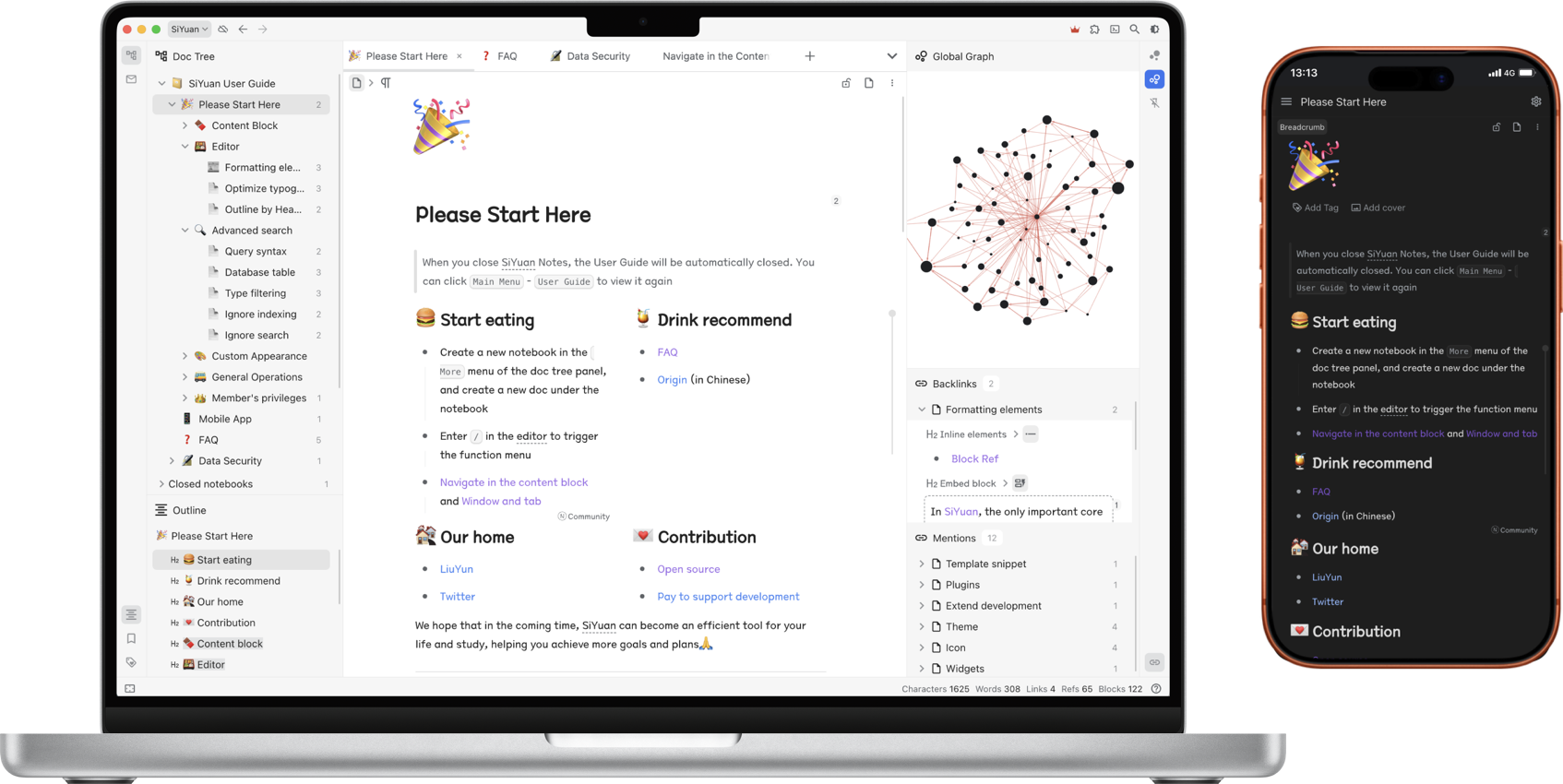
SiYuan is a privacy-first personal knowledge management system, supporting fine-grained block-level reference and Markdown WYSIWYG.
Welcome to SiYuan English Discussion Forum to learn more.

🔮 Features
Most features are free, even for commercial use.
- Content block
- Block-level reference and two-way links
- Custom attributes
- SQL query embed
- Protocol
siyuan://
- Editor
- Block-style
- Markdown WYSIWYG
- List outline
- Block zoom-in
- Million-word large document editing
- Mathematical formulas, charts, flowcharts, Gantt charts, timing charts, staves, etc.
- Web clipping
- PDF Annotation link
- Export
- Block ref and embed
- Standard Markdown with assets
- PDF, Word and HTML
- Copy to WeChat MP, Zhihu and Yuque
- Database
- Table view
- Flashcard spaced repetition
- AI writing and Q/A chat via OpenAI API
- Tesseract OCR
- Multi-tab, drag and drop to split screen
- Template snippet
- JavaScript/CSS snippet
- Android/iOS/HarmonyOS App
- Docker deployment
- API
- Community marketplace
Some features are only available to paid members, for more details please refer to Pricing.
🏗️ Architecture and Ecosystem
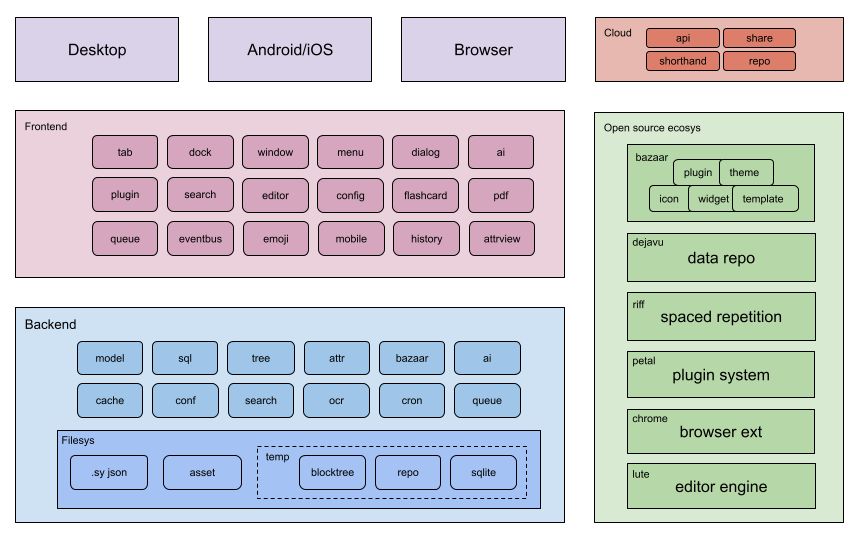
| Project | Description | Forks | Stars |
|---|---|---|---|
| lute | Editor engine |  |
 |
| chrome | Chrome/Edge extension |  |
 |
| bazaar | Community marketplace |  |
 |
| dejavu | Data repo |  |
 |
| petal | Plugin API |  |
 |
| android | Android App |  |
 |
| ios | iOS App |  |
 |
| harmony | HarmonyOS App |  |
 |
| riff | Spaced repetition |  |
 |
🌟 Star History
🗺️ Roadmap
🚀 Download Setup
It is recommended to give priority to installing through the application market on desktop and mobile, so that you can upgrade the version with one click in the future.
App Market
Mobile:
Desktop:
Installation Package
Package Manager
siyuan

siyuan-note

Docker Hosting
Docker Deployment
Overview
The easiest way to serve SiYuan on a server is to deploy it through Docker.
- Image name
b3log/siyuan - Image URL
File structure
The overall program is located under /opt/siyuan/, which is basically the structure under the resources folder of the Electron installation package:
- appearance: icon, theme, languages
- guide: user guide document
- stage: interface and static resources
- kernel: kernel program
Entrypoint
The entry point is set when building the Docker image: ENTRYPOINT ["/opt/siyuan/entrypoint.sh"]. This script allows changing the PUID and PGID of the user that will run inside the container. This is especially relevant to solve permission issues when mounting directories from the host. The PUID (User ID) and PGID (Group ID) can be passed as environment variables, making it easier to ensure correct permissions when accessing host-mounted directories.
Use the following parameters when running the container with docker run b3log/siyuan:
--workspace: Specifies the workspace folder path, mounted to the container via-von the host--accessAuthCode: Specifies the access authorization code
More parameters can be found using --help. Here’s an example of a startup command with the new environment variables:
docker run -d \
  -v workspace_dir_host:workspace_dir_container \
  -p 6806:6806 \
  -e PUID=1001 -e PGID=1002 \
  b3log/siyuan \
  --workspace=workspace_dir_container \
  --accessAuthCode=xxx
PUID: Custom user ID (optional, defaults to1000if not provided)PGID: Custom group ID (optional, defaults to1000if not provided)workspace_dir_host: The workspace folder path on the hostworkspace_dir_container: The path of the workspace folder in the container, as specified in--workspace- Alternatively, it's possible to set the path via the
SIYUAN_WORKSPACE_PATHenv variable. The commandline will always have the priority, if both are set
- Alternatively, it's possible to set the path via the
accessAuthCode: Access authorization code (please be sure to modify, otherwise anyone can access your data)- Alternatively, it's possible to set the auth code via the
SIYUAN_ACCESS_AUTH_CODEenv variable. The commandline will always have the priority, if both are set - To disable the Access authorization code set the env variable
SIYUAN_ACCESS_AUTH_CODE_BYPASS=true
- Alternatively, it's possible to set the auth code via the
To simplify things, it is recommended to configure the workspace folder path to be consistent on the host and container, such as having both workspace_dir_host and workspace_dir_container configured as /siyuan/workspace. The corresponding startup command would be:
docker run -d \
  -v /siyuan/workspace:/siyuan/workspace \
  -p 6806:6806 \
  -e PUID=1001 -e PGID=1002 \
  b3log/siyuan \
  --workspace=/siyuan/workspace/ \
  --accessAuthCode=xxx
Docker Compose
For users running Siyuan with Docker Compose, the environment variables PUID and PGID can be passed to customize the user and group IDs. Here's an example of a Docker Compose configuration:
version: "3.9"
services:
  main:
    image: b3log/siyuan
    command: ['--workspace=/siyuan/workspace/', '--accessAuthCode=${AuthCode}']
    ports:
      - 6806:6806
    volumes:
      - /siyuan/workspace:/siyuan/workspace
    restart: unless-stopped
    environment:
      # A list of time zone identifiers can be found at https://en.wikipedia.org/wiki/List_of_tz_database_time_zones
      - TZ=${YOUR_TIME_ZONE}
      - PUID=${YOUR_USER_PUID}  # Customize user ID
      - PGID=${YOUR_USER_PGID}  # Customize group ID
In this setup:
PUIDandPGIDare set dynamically and passed to the container- If these variables are not provided, the default
1000will be used
By specifying PUID and PGID in the environment, you avoid the need to explicitly set the user directive (user: '1000:1000') in the compose file. The container will dynamically adjust the user and group based on these environment variables at startup.
User Permissions
In the image, the entrypoint.sh script ensures the creation of the siyuan user and group with the specified PUID and PGID. Therefore, when the host creates a workspace folder, pay attention to setting the user and group ownership of the folder to match the PUID and PGID you plan to use. For example:
chown -R 1001:1002 /siyuan/workspace
If you use custom PUID and PGID values, the entrypoint script will ensure that the correct user and group are created inside the container, and ownership of mounted volumes will be adjusted accordingly. There’s no need to manually pass -u in docker run or docker-compose as the environment variables will handle the customization.
Hidden port
Use an NGINX reverse proxy to hide port 6806. Please note:
- Configure the WebSocket reverse proxy for
/ws
Note
- Be sure to confirm the correctness of the mounted volume, otherwise the data will be lost after the container is deleted
- Do not use URL rewriting for redirection, otherwise there may be problems with authentication, it is recommended to configure a reverse proxy
- If you encounter permission issues, verify that the
PUIDandPGIDenvironment variables match the ownership of the mounted directories on your host system
Limitations
- Does not support desktop and mobile application connections, only supports use on browsers
- Export to PDF, HTML and Word formats is not supported
- Import Markdown file is not supported
Unraid Hosting
Unraid Deployment
Note: First run chown -R 1000:1000 /mnt/user/appdata/siyuan in the terminal
Template reference:
Web UI: 6806
Container Port: 6806
Container Path: /home/siyuan
Host path: /mnt/user/appdata/siyuan
PUID: 1000
PGID: 1000
Publish parameters: --accessAuthCode=******(Access authorization code)
TrueNAS Hosting
TrueNAS Deployment
Note: First, run the commands below in the TrueNAS Shell. Please update Pool_1/Apps_Data/siyuan to match your dataset path.
zfs create Pool_1/Apps_Data/siyuan
chown -R 1001:1002 /mnt/Pool_1/Apps_Data/siyuan
chmod 755 /mnt/Pool_1/Apps_Data/siyuan
Navigate to Apps - DiscoverApps - More Options (on top right, besides Custom App) - Install via YAML
Template reference:
services:
  siyuan:
    image: b3log/siyuan
    container_name: siyuan
    command: ['--workspace=/siyuan/workspace/', '--accessAuthCode=2222']
    ports:
      - 6806:6806
    volumes:
      - /mnt/Pool_1/Apps_Data/siyuan:/siyuan/workspace  # Adjust to your dataset path
    restart: unless-stopped
    environment:
      - TZ=America/Los_Angeles  # Replace with your timezone if needed
      - PUID=1001
      - PGID=1002
Insider Preview
We release insider preview before major updates, please visit https://github.com/siyuan-note/insider.
🏘️ Community
🛠️ Development Guide
See Development Guide.
❓ FAQ
How does SiYuan store data?
The data is saved in the workspace data folder:
assetsis used to save all inserted assetsemojisis used to save emoji imagessnippetsis used to save code snippetsstorageis used to save query conditions, layouts and flashcards, etc.templatesis used to save template snippetswidgetsis used to save widgetspluginsis used to save pluginspublicis used to save public data- The rest of the folders are the notebook folders created by the user, files with the suffix of
.syin the notebook folder are used to save the document data, and the data format is JSON
Does it support data synchronization through a third-party sync disk?
Data synchronization through third-party synchronization disks is not supported, otherwise data may be corrupted.
Although it does not support third-party sync disks, it supports connecting with third-party cloud storage (Members' privileges).
In addition, you can also consider manually exporting and importing data to achieve data synchronization:
- Desktop: Settings - Export - Export Data / Import Data
- Mobile: Right column - About - Export Data / Import Data
Is SiYuan open source?
SiYuan is completely open source, and contributions are welcome:
For more details, please refer to Development Guide.
How to upgrade to a new version?
- If installed via app store, please update via app store
- If it is installed through the installation package on the desktop, you can enable the option of Settings - About - Automatically download update installation package, so that SiYuan will automatically download the latest version of the installation package and prompt to install
- If it is installed by manual installation package, please download the installation package again to install
You can Check update in Settings - About - Current Version, or pay attention to Official Download or GitHub Releases to get the new version.
What if some blocks (such as paragraph blocks in list items) cannot find the block icon?
The block icon is omitted for the first sub-block under the list item. You can move the cursor into this block and trigger its block menu with Ctrl+/ .
What should I do if the data repo key is lost?
-
If the data repo key is correctly initialized on multiple devices previously, the key is the same on all devices and can be retrieved in Settings - About - Data repo key - Copy key string
-
If it has not been configured correctly before (for example, the keys on multiple devices are inconsistent) or all devices are unavailable and the key string cannot be obtained, you can reset the key by following the steps below:
- Manually back up the data, you can use Export Data or directly copy the workspace/data/ folder on the file system
- Settings - About - Data repo key - Reset data repo
- Reinitialize the data repo key. After initializing the key on one device, other devices import the key
- The cloud uses the new synchronization directory, the old synchronization directory is no longer available and can be deleted
- The existing cloud snapshots are no longer available and can be deleted
Do I need to pay for it?
Most features are free, even for commercial use.
Member's privileges can only be used after payment, please refer to Pricing.
🙏 Acknowledgement
The birth of SiYuan is inseparable from many open source projects and contributors. Please refer to the project source code kernel/go.mod, app/package.json and project homepage.
The growth of SiYuan is inseparable from user feedback and promotion. Thank you, everyone, for your help with SiYuan ❤️
Contributors
Welcome to join us and contribute code to SiYuan together.